Art Deco style: the glamour of the 1920s and 30s
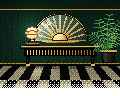
Art Deco is a design style of the 1920s and 1930s, named after the 1925 Paris exhibition of modern decorative arts: bold geometric patterns such as sunbursts, fans, chevrons and zigzags, glossy black lacquer, brass, chrome and mirror, and rich colours such as emerald, gold and black.
What is Art Deco style?
Art Deco is the look of the years between the two world wars: cocktail bars, ocean liners, cinemas and skyscrapers such as the Chrysler Building of 1930. It is modern and glamorous at once. Shapes are bold and geometric, surfaces shine, and rooms are arranged with the symmetry of a stage set.
The name comes from the Exposition internationale des arts décoratifs et industriels modernes, held in Paris in 1925, where designers such as Émile-Jacques Ruhlmann and René Lalique showed their work. At the time the style was called Style Moderne. "Art Deco" became its usual name only after Bevis Hillier's book of 1968. It drew on Cubism, on the bright colours of Fauvist painting and the Russian ballet, and on ancient Egypt, after Tutankhamun's tomb was excavated in 1922. Makers used rare materials such as ebony, and new ones such as chrome plating.
The Art Deco look in five signs
- Bold geometry. Sunbursts, fans, chevrons, zigzags and stepped shapes, on mirrors, rugs, lights and walls.
- Shine. Black lacquer, mirror, chrome, polished brass and marble.
- Black with gold. The pair that marks the style, lightened with ivory.
- Symmetry. A mirror centred over a console, a lamp at each end, chairs in pairs.
- One jewel colour. Emerald, sapphire or ruby, in velvet or on the walls.
Art Deco colours
Build the room on black and a pale ivory or champagne, add gold or brass in the metal, then choose one deep colour and commit to it. Deep emerald walls with a black console and a gold mirror is the classic. Keep to that one jewel tone, so the geometry stays the star.
- #FBE7A6IvoryLampshades, ceilings, a rug.
- #B3A784ChampagneWalls, or the pale floor tile.
- #E2BC5CGoldThe mirror, lamp bases, trims.
- #B98A2EBrassHandles, table legs, rails.
- #113426Deep emeraldWalls or velvet.
- #0B0B0BBlackLacquer furniture, the dark floor tile.
Art Deco materials, furniture and lighting
- Woods
- Dark and glossy: ebony, walnut with a strong figure, and wood lacquered black.
- Fabrics
- Velvet, satin, silk and leather, plain or in a bold geometric print.
- Other materials
- Chrome, brass, mirror, etched and frosted glass, marble and lacquer.
- Furniture
- Curved, streamlined or stepped: a tub chair, a shell-backed chair, a cocktail cabinet, a console table, a mirrored dressing table. Corners are rounded and fronts are smooth.
- Lighting
- Globe lamps in opal glass, fan-shaped wall lights that throw light upwards, and tiered pendants in glass and brass.
Art Deco room by room
An Art Deco living room
A velvet sofa in the jewel colour, two tub chairs facing it, and a low table in glass or mirror between them. Against the main wall, a console with a fan or sunburst mirror above it and a globe lamp on top. Two rules designers use: a mirror or picture over a console is about two thirds of its width, and hangs 15–25 cm above it (how high to hang pictures). Add a drinks trolley and a rug with a stepped or fan border.
An Art Deco bedroom
A velvet headboard with a curved or scalloped top, a mirrored bedside table at each side and a pair of globe lamps. Satin or sateen bed linen in ivory keeps the dark colours from closing in.
An Art Deco hall or bathroom
The style suits small rooms, where a little drama goes a long way. A black-and-white chequered floor, chrome fittings, a stepped mirror, and a geometric wallpaper in gold on black. The wallpaper calculator counts the rolls and allows for the pattern repeat.
Art Deco on a budget, in a rented flat
- Start with the mirror. A fan or sunburst mirror in gold is the quickest way into the style. Lean it on a chest if you cannot hang it.
- Add velvet. Two cushion covers in emerald or sapphire velvet.
- Swap a lamp. A globe lamp with a brass or black base.
- Frame the period. Travel and cinema posters of the 1920s and 30s, in thin black or gold frames.
- Look for 1930s furniture. Walnut-veneer cabinets and dressing tables of the time often cost little second-hand.
What to avoid
- Gold on everything. It is a line and a highlight. Too much, and the room turns into a casino.
- Shine with no rest. Balance lacquer and mirror with velvet, matt walls and a wool rug.
- Several patterns at once. One strong geometric per room: the floor, the wallpaper or the rug.
- Party props. Feathers and strings of pearls are fancy dress. The real style is in the shapes and the materials.
Art Deco vs maximalist, and Art Deco vs mid-century modern
Art Deco vs maximalist
Both are bold and rich. Art Deco is ordered: a tight palette, symmetry, clean geometry and a few statement pieces. Maximalism is abundant: many colours, pattern on pattern, things from every period and something on every surface.
Art Deco vs mid-century modern
Art Deco came first, in the 1920s and 30s, and it dresses for the evening: black, gold, mirror and velvet. Mid-century modern followed after 1945 and is made for daytime family life: oiled teak, slim legs, soft curves and mustard or teal.
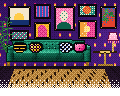 Maximalist
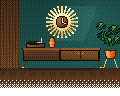 Mid-century modern
Art Deco questions
What is Art Deco style?
The design style of the 1920s and 1930s. It joins bold geometry, such as sunbursts, fans, chevrons and stepped shapes, with glossy and costly-looking materials: black lacquer, brass, chrome, mirror, marble and velvet. Rooms are symmetrical and dressed up.
Why is it called Art Deco?
After the Exposition internationale des arts décoratifs et industriels modernes, held in Paris in 1925. The short name came later: the style was called Style Moderne at the time, and "Art Deco" became usual after Bevis Hillier's book of 1968.
What colours are Art Deco?
Black and gold first, with ivory or champagne to lighten them. Then one deep jewel colour, such as emerald, sapphire or ruby. Chrome and mirror add silver. The early style took bright colour from Fauvist painting and the Russian ballet.
What is the difference between Art Deco and Art Nouveau?
Art Nouveau came first and fell out of fashion before the First World War. It is made of flowing curves drawn from plants. Art Deco followed in the 1920s and is geometric: straight lines, zigzags, circles and stepped forms.
What are Art Deco motifs?
Sunbursts, fans, chevrons, zigzags, stepped pyramids and stylised flowers. Egyptian motifs such as lotus flowers and scarabs joined them after Tutankhamun's tomb was excavated in 1922.
Editorial notes
Written by the Snuug team and checked on 11 November 2026. The dates and names come from the sources below. A number with no source beside it is a designers' rule of thumb, not a study. The picture and its colours are Snuug's own pixel art.
- Victoria and Albert Museum, An introduction to Art Deco (the 1925 Paris exhibition; Style Moderne; Tutankhamun, 1922; Cubism and the Russian ballet; zigzags; Ruhlmann and Lalique; Art Nouveau). Read 11 Nov 2026
- Wikipedia, Art Deco (the exhibition's full name; Bevis Hillier, 1968; Fauvism and the Ballets Russes; ebony and ivory; chrome plating; chevrons and zigzags; the Chrysler Building, 1930). Read 11 Nov 2026
- Grustat, 15 Essential Interior Design Styles to Know Now, Architectural Digest, 5 Aug 2025 (lacquer, chrome and gilt). Read for the app's style test in October 2026; the page refused our fetch on 11 Nov 2026