Mid-century modern: warm wood, slim legs and confident colour
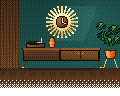
Mid-century modern is an interior design style from roughly 1945 to 1970: low, clean-lined furniture in warm woods such as teak and walnut on slim tapered legs, soft organic curves, and a few confident colours such as mustard, burnt orange, olive and teal.
What is mid-century modern style?
Mid-century modern is the furniture and decoration of the years after the Second World War, when designers set out to make modern things for ordinary family homes. The pieces are low, light and clean-lined, in warm wood on slim legs. The rooms are informal and bright, with a few strong colours and little ornament.
The style was most popular from roughly 1945 to 1970, in North America, Brazil and Europe. The term was in use by the mid-1950s, and Cara Greenberg fixed it as the name of a design movement in her 1984 book Mid-Century Modern: Furniture of the 1950s. Its best-known pieces include the Eames Lounge Chair of 1956 and Arne Jacobsen's Egg chair of 1958. In Britain, E Gomme of High Wycombe launched G-Plan in 1953: modern furniture, much of it in teak, to be bought piece by piece.
The mid-century modern look in five signs
- Tapered legs. Sofas, chairs and cabinets stand on slim legs that narrow to the floor, often splayed.
- A long, low sideboard. In teak or walnut, with sliding doors or plain fronts.
- Soft, organic curves. A shell chair, a kidney-shaped table, an armchair like an egg.
- Two confident colours. Mustard with teal, or burnt orange with olive, against warm wood.
- A graphic accent. A sunburst clock or mirror, a globe lamp, an abstract print.
Mid-century modern colours
Wood is the main colour, so start there. Keep most walls cream or white, and paint one in a deep tone such as teal if you like. Then choose two strong colours and repeat each two or three times: a cushion, a chair, a vase, a print.
- #FFEDB8CreamMost of the walls, lampshades.
- #C4943EMustardA chair, cushions, brass.
- #D85E1ABurnt orangeOne armchair or a pot.
- #1C4F4ATealOne wall, or the sofa.
- #245E30Leaf greenLarge houseplants.
- #5E3A1EWalnutSideboard, table, chair frames.
Mid-century modern materials, furniture and lighting
- Woods
- Teak, walnut, rosewood and oak, oiled to a soft glow, not varnished to a shine. Veneer and moulded plywood are part of the style.
- Fabrics
- Wool tweed, bouclé, leather, corduroy and velvet. Geometric and abstract prints.
- Other materials
- Brass, chrome, glass and moulded plastic.
- Furniture
- A sideboard, a lounge chair, shell dining chairs, a nest of tables, a wall of open shelving, a round pedestal table. Everything is raised off the floor.
- Lighting
- An arc floor lamp over the sofa, globe and bubble pendants, a tripod lamp, brass stems. Lights are shapes to look at, as well as lamps.
Mid-century modern room by room
A mid-century modern living room
Let the sideboard anchor the room, with a lamp, a record player and a plant on top. Hang a sunburst mirror or one large print above it. Two rules designers use: the art is about two thirds of the sideboard's width, and its lower edge sits 15–25 cm above the top (how high to hang pictures). Choose a sofa on legs, set one armchair at an angle, and add a plain or geometric wool rug. If the television stands on the sideboard, see living room layout with a TV.
A mid-century modern dining room
A round or extending teak table, shell or spindle-back chairs, and one pendant low over the centre. A sideboard along the wall holds the china.
A mid-century modern bedroom
A low bed with a plain wooden headboard, bedside tables on tapered legs, and bedding in cream with one mustard or teal blanket. One globe lamp on each side is enough decoration.
Mid-century modern on a budget, in a rented flat
The real thing is easy to find second-hand in Britain, and can cost less than a new copy.
- Hunt for a sideboard. Pieces by British makers such as G-Plan and Ercol turn up at auctions, in charity shops and online. Measure the doorways and the stairs before you buy one.
- Change the legs. Tapered wooden legs screw onto many sofas and cabinets in place of the feet they came with.
- Pick two colours. Buy cushion covers and a throw in those two, and put the rest away.
- Hang a sunburst. A sunburst mirror or clock names the style at once.
- Raise a plant. A large-leaved plant on a wooden stand, beside the sideboard.
To check a large piece against your door, try the will it fit calculator.
What to avoid
- The time capsule. If every single thing is from 1960, the room becomes a film set. Mix in pieces from today.
- All the colours at once. Mustard, orange, teal and olive together are too much for one room. Two is plenty.
- Furniture that sits on the floor. Boxy pieces with no legs take away the lightness.
- High gloss. Lacquer and mirror belong to Art Deco. Here the wood is oiled and matt.
Mid-century modern vs Scandinavian, and vs Art Deco
Mid-century modern vs Scandinavian
The two overlap, and several famous mid-century pieces are Scandinavian. As looks for a room they differ in temperature. Scandinavian is pale and cool: white walls, birch and pine, almost no colour. Mid-century modern is warm and deep: teak and walnut, mustard and teal.
Mid-century modern vs Art Deco
Both belong to a period and both love geometry. Art Deco, from the 1920s and 30s, is formal and glamorous: black lacquer, mirror, gold and symmetry. Mid-century modern is relaxed and domestic: oiled wood, soft curves and furniture for family life.
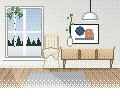 ScandinavianThe simple style of the Nordic countries.
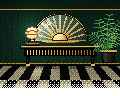 Art DecoThe glamorous style of the 1920s and 30s.
Mid-century modern questions
What years are mid-century modern?
Roughly 1945 to 1970. The style was most popular in North America, Brazil and Europe in those years. Most people mean the 1950s and 60s when they use the term.
What defines mid-century modern furniture?
Clean lines, warm wood such as teak and walnut, slim tapered legs that lift each piece off the floor, and soft curved shapes. Pieces are low and light-looking, with little or no ornament, and materials are used honestly.
What colours are mid-century modern?
Warm wood tones with a few confident colours: mustard, burnt orange, olive or leaf green and teal, on cream or white. Use two of the strong colours in one room, not all of them.
What is the difference between mid-century modern and Scandinavian style?
They grew up in the same years and share clean lines. Scandinavian rooms are paler and quieter, with white walls and birch or pine. Mid-century modern rooms use darker, warmer teak and walnut and stronger colour.
Where does the term mid-century modern come from?
It was in use by the mid-1950s. The writer Cara Greenberg defined it as a design movement in her 1984 book Mid-Century Modern: Furniture of the 1950s.
Editorial notes
Written by the Snuug team and checked on 11 November 2026. The dates and names come from the sources below. A number with no source beside it is a designers' rule of thumb, not a study. The picture and its colours are Snuug's own pixel art.
- Wikipedia, Mid-century modern (roughly 1945 to 1970; the term, and Cara Greenberg, 1984; honest use of materials). Read 11 Nov 2026
- Grustat, 15 Essential Interior Design Styles to Know Now, Architectural Digest, 5 Aug 2025 (the 1950s and 60s; warm wood, the colours, brass and chrome). Read for the app's style test in October 2026; the page refused our fetch on 11 Nov 2026
- Wikipedia, Charles and Ray Eames (the Eames Lounge Chair, 1956). Read 11 Nov 2026
- Wikipedia, Scandinavian design (Arne Jacobsen's Egg chair, 1958). Read 11 Nov 2026
- Wikipedia, G-Plan (E Gomme Ltd of High Wycombe, 1953; teak; a Danish Modern range in the early 1960s). Read 11 Nov 2026