Minimalist style: only what the room needs
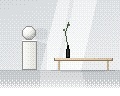
Minimalist interior design is a style that reduces a room to what it needs: clear surfaces, plain pale walls, a few simple, well-made pieces of furniture, hidden storage and one or two colours, so that space and light do the decorating.
What is minimalist style?
Minimalism reduces a thing to its necessary elements. In a room that means fewer objects, fewer colours and fewer lines, each one chosen with care. The reward is space: clear floors, calm surfaces and daylight moving across a plain wall.
Its best-known motto is "Less is more", adopted by the architect Ludwig Mies van der Rohe (1886–1969). Adolf Loos had argued against decoration earlier still, in Ornament and Crime (1913). Minimalist design also owes a great deal to traditional Japanese architecture and to Zen, including the idea of Ma: empty, open space. Minimal art emerged in New York in the early 1960s, and minimalist architecture became popular in the late 1980s in London and New York, in the work of architects such as John Pawson and Tadao Ando.
The minimalist look in five signs
- Clear surfaces. Worktops, tables and shelves hold one thing, or nothing.
- Storage you cannot see. Flat doors, often with no handles, hide what the room needs.
- One or two colours. White with one material, such as pale oak or grey stone, and little else.
- Simple shapes with room around them. A few low pieces in straight lines and plain curves, each with empty floor beside it.
- No pattern, no ornament. Interest comes from proportion, texture and light.
Minimalist colours
Use close tones of white and grey, and let one natural material give the warmth. Then add black once: a vase, a lamp, a picture frame. The fewer the colours, the more the textures matter, so mix matt plaster with wool, wood and stone.
- #FAFBFBPaper whiteCeilings and woodwork.
- #ECEEF0CloudThe walls.
- #DADDE0Pale greyThe sofa, cabinets, a rug.
- #C4C7C9Stone greyFloors and worktops.
- #DCC8AAPale oakThe one wood: a bench, a table.
- #050505BlackOne small object.
Minimalist materials, furniture and lighting
- Woods
- Pale oak, ash, birch or maple with a quiet grain. One wood for the whole room.
- Fabrics
- Plain wool, linen and cotton in the wall colour or close to it. Texture, not print.
- Other materials
- Smooth plaster, concrete, stone, glass, steel and lacquer.
- Furniture
- Low and exact: a sofa with a straight back, a platform bed, a plain bench, built-in cupboards from floor to ceiling. Buy fewer pieces and better ones.
- Lighting
- Plain fittings that do not draw the eye: recessed downlights, one simple pendant, a slim floor lamp. A rule installers use: space downlights about half the ceiling height apart, so 1.2 m under a 2.4 m ceiling.
Minimalist room by room
A minimalist living room
A sofa, one low table, one lamp and one large picture are enough. Hang the picture so its centre is 145–150 cm from the floor, a rule designers use. Mount the television and hide its cables. Give every other thing a home behind a door. Then check the paths: a rule designers use is to keep walkways 75–90 cm wide. Every figure is in living room measurements.
A minimalist bedroom
A low bed, bed linen in one colour, and a small surface on each side with a lamp and nothing else. Wardrobes with flat doors, to the ceiling if you can. Nothing is kept on top of them, or on show under the bed.
A minimalist kitchen
Handleless units, the kettle and toaster in a cupboard, and one material for the worktop and the wall behind it. Leave a single bowl or board out, for use and for looks.
Minimalist style on a budget, in a rented flat
You take things away, so most of this costs nothing.
- Clear one surface at a time. Take everything off. Put back only what you use every day.
- Box the rest. Store it out of sight for a month. What you did not fetch, you can sell or give away.
- Hide the cables. A cable box and a few clips tidy a television corner.
- Bring the textiles to one colour. Cushion covers, throws and bed linen in the same pale tone as the walls.
- Buy storage last. Sort first. Then buy plain boxes with lids, in the colour of the wall they stand against.
A clear room also looks larger. Ten more moves are in how to make a room look bigger.
What to avoid
- Empty without warmth. Bright white, hard floors and cool bulbs together can look bare. Keep one wood, one soft textile and warm white light.
- Clutter moved, not removed. Open shelves of boxes are still busy. The style needs doors.
- Many small things. One large picture or plant does more than ten small ones.
- Rules over comfort. Keep the chair you love to sit in. A room is for living in.
Minimalist vs Scandinavian, and minimalist vs Japandi
Minimalist vs Scandinavian
A Scandinavian room is simple but homely: you see wood grain, a sheepskin, candles, plants on the sill. A minimalist room goes further and puts those away too. Its surfaces are smoother, its colours fewer and its storage hidden.
Minimalist vs Japandi
Both keep very little on show. Japandi is the warmer and darker of the two: oat walls, two woods, black lines and handmade pots. Minimalist rooms are paler and cooler, with less wood and more plaster, stone and glass.
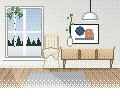 ScandinavianThe simple style of the Nordic countries.
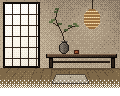 JapandiJapanese and Scandinavian design, mixed.
Minimalist questions
What is minimalist interior design?
A style that reduces a room to what it needs. Surfaces are clear, walls are plain, storage is hidden behind flat doors, and a few simple pieces of furniture stand with space around them. The palette is one or two quiet colours.
What colours are used in minimalist design?
White, off-white and pale grey, with the colour of one natural material such as pale oak or stone. Black is used as a single small accent. Keep to one or two colours and vary the texture.
How do I stop a minimalist room looking cold?
Keep the shapes plain and warm up the materials. Use off-white in place of bright white, add one wood, choose wool, linen or bouclé for the sofa and the rug, and light the room with warm white lamps at a low height.
Who said "less is more"?
The architect Ludwig Mies van der Rohe (1886–1969) adopted it as his motto. The designer Dieter Rams has a similar one: "Less but better."
Is minimalist the same as Scandinavian style?
No. Both are simple, but a Scandinavian room keeps wood grain, wool, candles and a few loved objects on show. A minimalist room puts almost everything away and keeps its surfaces smooth and clear.
Editorial notes
Written by the Snuug team and checked on 11 November 2026. The dates and names come from the sources below. A number with no source beside it is a designers' rule of thumb, not a study. The picture and its colours are Snuug's own pixel art.
- Wikipedia, Minimalism (reduced to its necessary elements; Mies van der Rohe, Less is more; Adolf Loos, 1913; the Japanese influence and Ma; London and New York in the late 1980s; John Pawson, Tadao Ando; minimal art in 1960s New York; Dieter Rams). Read 11 Nov 2026
- Grustat, 15 Essential Interior Design Styles to Know Now, Architectural Digest, 5 Aug 2025 (clean surfaces and walls; the neutral palette). Read for the app's style test in October 2026; the page refused our fetch on 11 Nov 2026